
Flavite
A desktop workspace for writing notes, connecting ideas, and exploring how they relate.
- Drawn by
- Lex
- Date
- 2026-11
- Scale
- 1 : 1
- Sheet
- 02 OF 05
- Write, read, search, and explore linked notes in a movable, split-pane desktop workspace.
- Multiple views of one note share text and undo history, with independent carets, selections, and scroll positions.
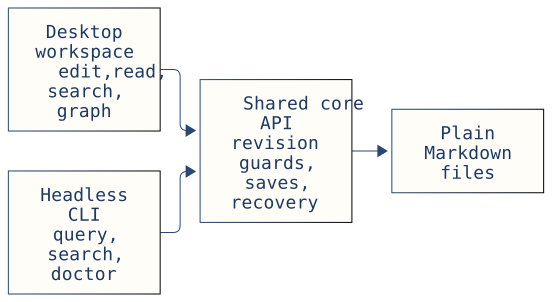
- The desktop application and command-line tools use the same core for working with notes.
- Notes remain plain Markdown files; the application requires no account or network service.
- Version checks, carefully coordinated saves, and explicit conflict and recovery handling support the editing workflow.

Scroll across the drawing to see the detail.
Flavite brings writing and the relationships between ideas into one workspace. A note can be open beside its preview, backlinks, outline, or a graph of connected notes. These views can follow your current context or stay pinned to a particular note, so exploration and writing can happen side by side. The underlying notes remain ordinary Markdown files in a folder you control. Markdown is plain text with lightweight notation for things such as headings and links. The application works locally, without an account or network service.
The desktop application is built in Rust with iced, a user-interface toolkit. Its workspace supports movable tabs and recursively split groups, with layouts saved per vault on the local device. The graph offers hardware-accelerated and software drawing, filters, and an explicit distinction between saved content and unsaved edits. A vault is simply the folder of notes the application is working with.
A shared foundation for different ways of working§
The interface sits over a core API, the shared set of operations also used by command-line tools that run without a graphical window. Editing, search, links, properties, history, and recovery are accessed through that boundary. The workspace layout model is separate from the interface toolkit and filesystem: proposed changes are checked before they become the new state.
This separation makes the desktop workspace and command-line tools different ways of working with the same vault. It also keeps responsibility for writes in the core, where version checks, atomic saves that replace a file in one step, recovery snapshots, and explicit conflict decisions can be applied consistently.
Current state§
Flavite is pre-release and in active development. The workspace shell and editor are usable; production packaging and parts of the interaction design are still in progress. Native accessibility, input behavior, and some visual workflows need further verification. The repository documents these boundaries alongside its setup and feature guides.
The project demonstrates how a persistent data model, editing engine, search index, graph, and desktop interface can form a coherent system while keeping the user’s files accessible independently of the application.